

📑 Table of Contents
- What is Saving?
- What is Investing?
- Saving vs. Investing Comparison
- Key Differences
- When Should You Save?
- When Should You Invest?
- Benefits of Saving
- Benefits of Investing
- Smart Financial Tips
- Common Mistakes
- Real-Life Example
- Frequently Asked Questions
- Conclusion
Saving vs. Investing: What's the Difference? (Complete Beginner's Guide 2026)
Many people use the terms saving and investing interchangeably, but they have different purposes. Saving helps you protect money for short-term needs and emergencies, while investing helps your money grow over the long term. Understanding the difference can help you make smarter financial decisions and achieve your financial goals faster.What is Saving?
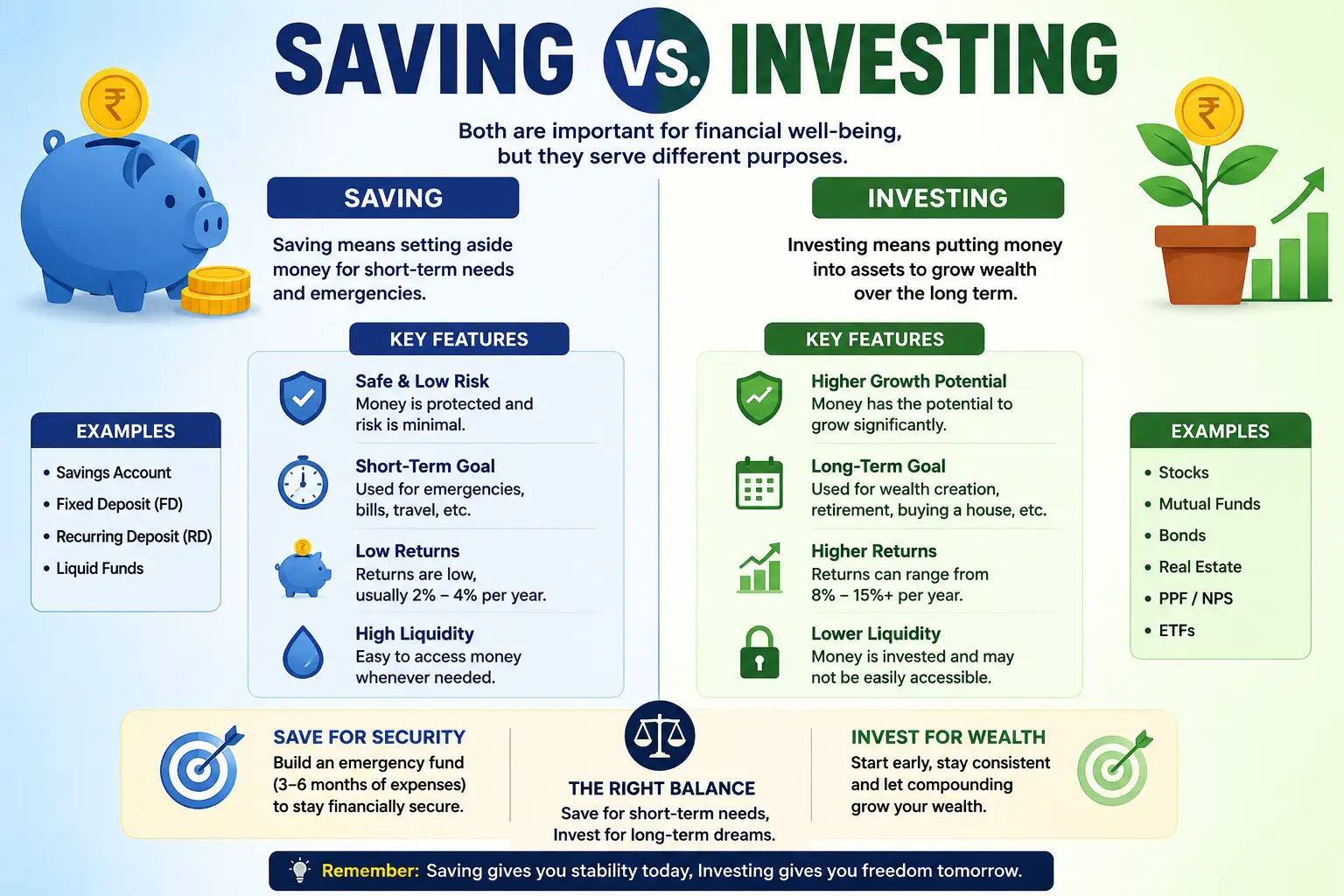
Saving means keeping money aside in a secure place so that it is available whenever you need it. It is mainly used for emergencies and short-term financial goals.
Common saving options include:
- Savings Account
- Fixed Deposit (FD)
- Recurring Deposit (RD)
- Cash Reserve
Example
Rahul earns ₹40,000 per month and saves ₹8,000 every month in his savings account. After one year, he has saved ₹96,000, which can be used for emergencies or planned expenses.
What is Investing?
Investing means putting your money into assets that have the potential to grow over time. Although investments involve some level of risk, they generally provide higher returns than savings over the long term.
Popular investment options include:
- Mutual Funds
- Stocks
- Exchange Traded Funds (ETFs)
- Bonds
- Gold
- Real Estate
- National Pension System (NPS)
Example
Priya invests ₹5,000 every month in an equity mutual fund through SIP. Assuming an average annual return of 12%, her investment can grow to approximately ₹50 lakh in 20 years because of the power of compounding.
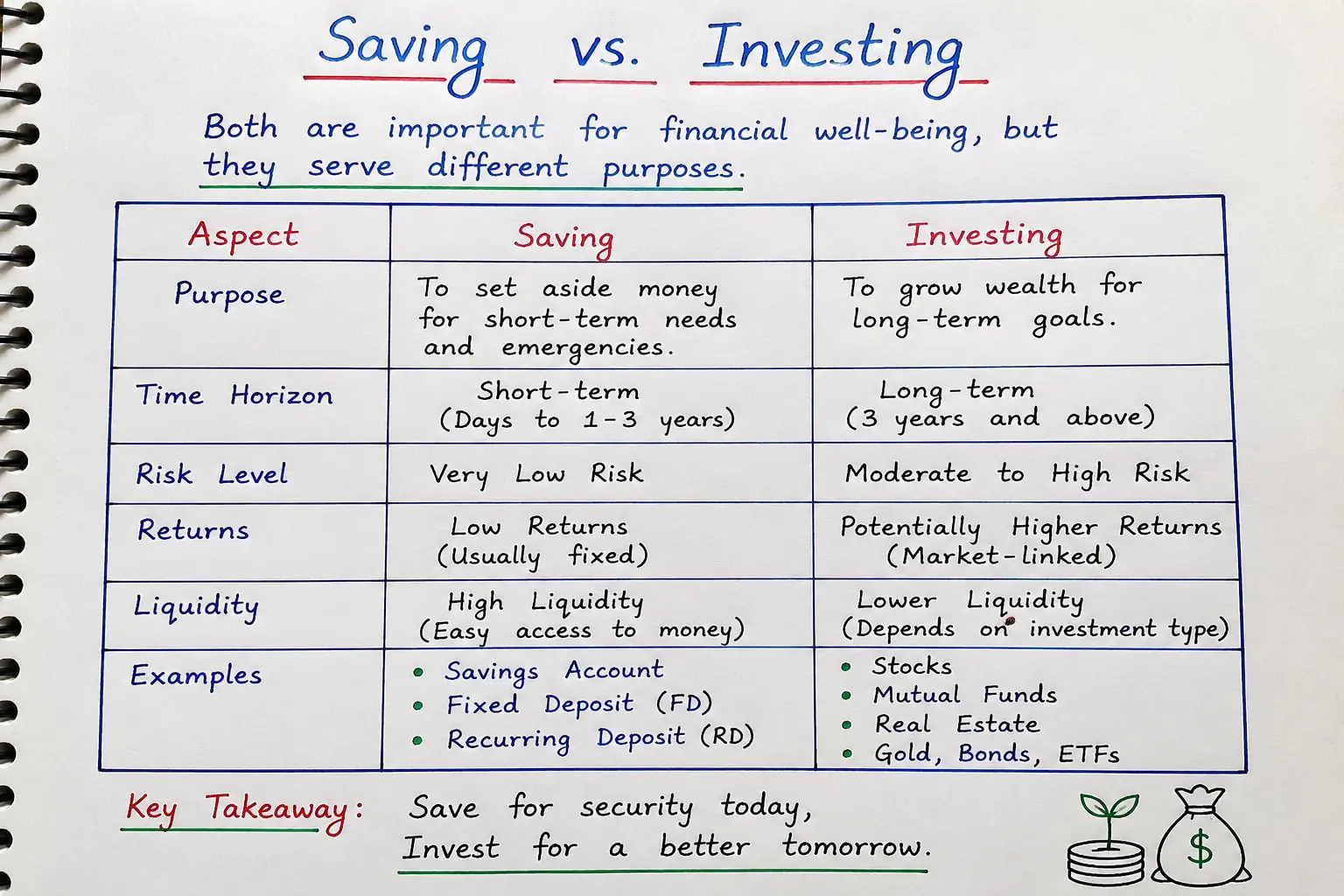
Saving vs. Investing Comparison
| Saving | Investing |
|---|---|
| Low Risk | Moderate to High Risk |
| Short-Term Goals | Long-Term Wealth Creation |
| Easy Access to Money | May Have Lock-in Period |
| Lower Returns | Higher Return Potential |
| Safe Capital | Market-Linked Growth |
Key Differences Between Saving and Investing
1. Purpose
Saving focuses on financial security and meeting short-term needs, while investing focuses on building long-term wealth.
2. Risk
Savings are generally safe with minimal risk, whereas investments can fluctuate in value depending on market conditions.
3. Returns
Savings offer lower but stable returns. Investments have the potential to generate significantly higher returns over time.
4. Liquidity
Savings can usually be accessed immediately, while some investments require a longer holding period.
When Should You Save?
- Build an emergency fund
- Medical expenses
- Education fees
- Travel or vacation planning
- Buying gadgets or appliances
- Short-term financial goals
When Should You Invest?
- Retirement planning
- Buying a house
- Children's higher education
- Long-term wealth creation
- Financial independence
Benefits of Saving
- Provides financial security
- Easy access to funds
- Very low risk
- Helps during emergencies
- Builds financial discipline
Benefits of Investing
- Higher return potential
- Beats inflation
- Creates long-term wealth
- Power of compounding
- Generates passive income
Smart Financial Tips
- Maintain an emergency fund covering 6–12 months of expenses.
- Start investing as early as possible.
- Diversify your investments.
- Invest regularly through SIP.
- Review your portfolio annually.
- Do not invest money needed in the short term.
Common Mistakes to Avoid
- Investing without an emergency fund.
- Keeping all money in a savings account.
- Ignoring inflation.
- Following investment tips without research.
- Investing without financial goals.
Real-Life Example
Suppose you receive a bonus of ₹1,00,000. Instead of using it all at once, you can divide it wisely:
- ₹30,000 → Emergency Savings
- ₹50,000 → Mutual Funds (SIP or Lump Sum)
- ₹10,000 → Gold Investment
- ₹10,000 → Personal Expenses
This balanced approach provides financial security while allowing your money to grow over time.
Frequently Asked Questions (FAQs)
Is saving safer than investing?
Yes. Saving is generally safer because it carries minimal risk, whereas investments are subject to market fluctuations.
Can beginners start investing?
Yes. Beginners should first build an emergency fund and then start investing through diversified options like mutual fund SIPs.
How much should I save every month?
A common recommendation is to save at least 20% of your monthly income, depending on your financial situation and goals.
Can I save and invest at the same time?
Absolutely. A balanced financial plan includes both saving for emergencies and investing for long-term wealth creation.
Which provides better returns?
Investments generally offer higher long-term return potential than savings, but they also involve greater risk.
Conclusion
Saving and investing are both essential components of a healthy financial plan. Saving provides stability and prepares you for unexpected expenses, while investing helps your money grow and keeps pace with inflation. By combining both strategies, you can achieve financial security today and build lasting wealth for the future.
Related Articles
- What is Budget Planning?
- What is an Emergency Fund?
- SIP vs Lump Sum Investment
- How to Start Investing in India
- Best Mutual Funds for Beginners
- Financial Planning Guide
&media=https://r2.mutualfundipo.app/blogpost/saving-vs-investing.webp)