
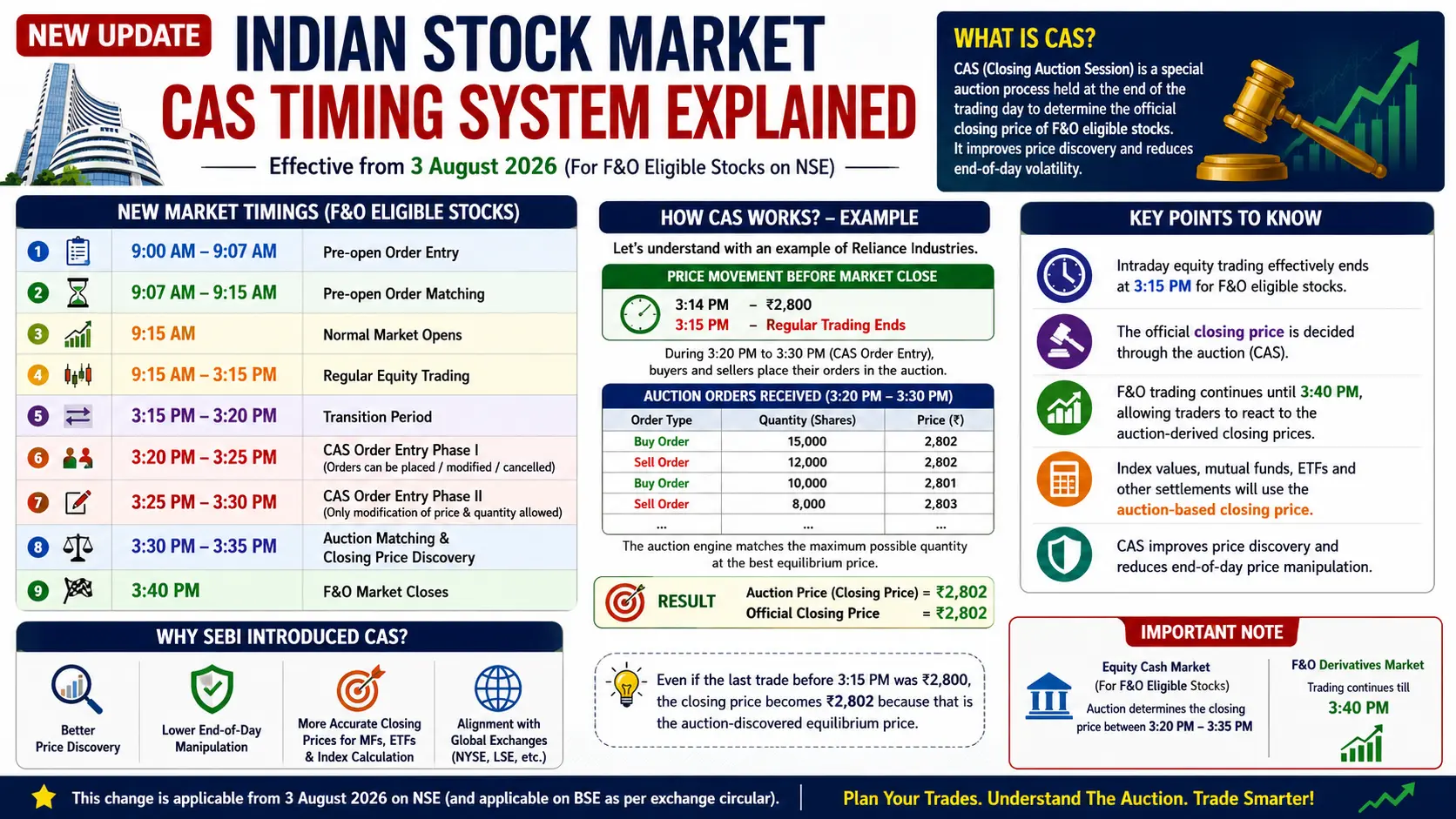
New CAS Timing System in Indian Stock Market (2026) — Explained Simply with an Example
Last updated: August 2026 | Category: Stock Market Basics
Starting 3 August 2026, SEBI has changed how the Indian stock market decides the closing price of shares. This new rule is called the Closing Auction Session (CAS). If you trade or invest in Indian stocks, this update changes your market timing, your order placement, and how the "close price" of a stock is calculated. In this guide, we explain the new CAS timing step by step, in plain and simple language, with a real example.
Table of Contents
- 1. What is CAS (Closing Auction Session)?
- 2. Why did SEBI introduce CAS?
- 3. Old Closing System vs New CAS System
- 4. New Stock Market Timings from 3 August 2026
- 5. Step-by-Step: How CAS Works (Time Wise)
- 6. Easy Example: CAS Timing with a Real Stock
- 7. Who is Affected by This Change?
- 8. What Should Traders and Investors Do?
- 9. Frequently Asked Questions (FAQ)
- 10. Conclusion
1. What is CAS (Closing Auction Session)?
CAS stands for Closing Auction Session. It is a new, short trading window held right at the end of the trading day. Its only job is to decide the official closing price of a stock in a fairer and more transparent way.
In simple words: instead of calculating the closing price using the last 30 minutes of normal trading, the exchange now collects all buy and sell orders in a short auction window and finds one single price at which the maximum number of shares can be traded. That price becomes the official closing price.
2. Why Did SEBI Introduce CAS?
SEBI brought in this change for a few clear reasons:
- Fair closing price: A single auction price is harder to manipulate than an average of trades.
- Reduce last-minute volatility: Big last-minute orders used to swing the closing price sharply.
- Match global standards: Major exchanges like NASDAQ and NYSE already use a closing auction system.
- Better price discovery: All orders are pooled together, so the price better reflects real demand and supply.
3. Old Closing System vs New CAS System
| Point | Old System (Before 3 Aug 2026) | New CAS System (From 3 Aug 2026) |
|---|---|---|
| How closing price is calculated | Volume Weighted Average Price (VWAP) of last 30 minutes (3:00 PM–3:30 PM) | Single auction price matching maximum buy/sell quantity |
| Applicable to | All stocks, same method for everyone | Only stocks that have F&O (Futures & Options) contracts, to start with |
| Market close time (cash segment) | 3:30 PM for all stocks | 3:15 PM for CAS stocks, 3:30 PM for non-CAS stocks |
| F&O trading close time | 3:30 PM | 3:40 PM (extended by 10 minutes) |
| Order types allowed near close | Market, limit, stop-loss, IOC orders as usual | Restricted — no stop-loss, no IOC orders during the auction window |
4. New Stock Market Timings from 3 August 2026
Here is the complete revised timeline for stocks that fall under CAS (i.e. stocks with F&O contracts):
| Time (IST) | What Happens |
|---|---|
| 9:15 AM | Market opens as usual (no change) |
| 3:00 PM – 3:15 PM | Reference price for CAS is calculated using VWAP of trades in this window |
| 3:15 PM | Normal continuous trading ends for CAS-eligible (F&O) stocks |
| 3:15 PM – 3:20 PM | Transition window: no new orders, no order modification allowed |
| 3:20 PM – 3:25 PM | CAS order entry window: both market and limit orders allowed |
| 3:25 PM – 3:30 PM | Only limit orders allowed; window closes randomly within this period |
| 3:30 PM – 3:35 PM | Exchange matches orders and announces the final closing price |
| 3:30 PM | Normal trading ends for non-F&O (non-CAS) stocks, as before |
| 3:40 PM | Futures & Options (derivatives) segment trading closes |
5. Step-by-Step: How CAS Works (Time Wise)
- Step 1 — Reference price is set: Between 3:00 PM and 3:15 PM, the exchange calculates a "reference price" from real trades. This acts as a base for the auction.
- Step 2 — Continuous trading stops: At exactly 3:15 PM, normal buy/sell trading pauses for CAS stocks.
- Step 3 — Cooling-off period: From 3:15 PM to 3:20 PM, no new orders can be placed or changed. This gives the system time to settle.
- Step 4 — Auction order entry: From 3:20 PM to 3:25 PM, traders can place fresh market or limit orders for the auction, within a set price band.
- Step 5 — Final order window: From 3:25 PM, only limit orders are accepted, and the exact closing moment is randomised within a few seconds so no one can predict it and game the system.
- Step 6 — Price matching: The exchange finds the one price at which the highest number of shares can be matched between buyers and sellers. This becomes the official closing price.
- Step 7 — Result declared: By around 3:35 PM, the new closing price is published and used for the next day's opening reference, index calculation, and mutual fund NAV.
6. Easy Example: CAS Timing with a Real Situation
Example: Suppose you hold shares of a large company that has F&O contracts (this makes it CAS-eligible). Here is how your trading day looks under the new system:
- 9:15 AM: You buy shares like any normal day.
- 3:00 PM: The exchange starts tracking trades to calculate the reference price.
- 3:15 PM: You try to place a quick sell order — but continuous trading has already stopped for this stock. Your order will now be part of the auction, not an instant trade.
- 3:15 PM – 3:20 PM: You wait. No orders can be entered right now.
- 3:20 PM: You place a limit sell order for the auction, say at the current market price.
- 3:25 PM – 3:30 PM: The system randomly closes the order window — you can no longer guess the exact second it will stop accepting orders.
- 3:30 PM: The exchange finds the single price where most buyers and sellers match, and that becomes today's official closing price for the stock — this is the price used for tomorrow's reference and for calculating index values.
Key takeaway from the example: A market order placed close to 3:15 PM will not execute at the last traded price. It goes into the auction and may get a different price, decided only after 3:30 PM.
7. Who is Affected by This Change?
- Intraday traders: Must square off positions before 3:15 PM for CAS stocks, since normal trading stops earlier than before.
- F&O traders: Get 10 extra minutes, since derivatives trading now closes at 3:40 PM instead of 3:30 PM.
- Long-term investors: Orders placed after 3:15 PM in CAS-eligible stocks will go through the auction process instead of instant execution.
- Mutual funds and index trackers: Will now use the new auction-based closing price for NAV and index calculations.
- Non-F&O stock investors: No real change for now — these stocks keep trading until 3:30 PM as before.
8. What Should Traders and Investors Do?
- Check whether the stock you are trading has F&O contracts — this decides if it falls under CAS.
- Place important orders before 3:15 PM if you want normal, instant execution.
- Avoid relying on stop-loss or IOC orders near market close for CAS stocks, since these are not allowed during the auction.
- If trading F&O, remember the new closing time is 3:40 PM, not 3:30 PM.
- Track official circulars from NSE and BSE, since CAS will be rolled out to more stocks in phases.
9. Frequently Asked Questions (FAQ)
Q1. From which date is CAS applicable?
CAS is applicable from 3 August 2026 for stocks that have active Futures & Options contracts.
Q2. Does CAS apply to all stocks?
No. In this first phase, CAS applies only to stocks that are also traded in the F&O segment. Other stocks continue with the old system for now.
Q3. What is the new market closing time?
For CAS stocks, continuous trading ends at 3:15 PM, and the auction runs until about 3:30–3:35 PM. Non-CAS stocks still close at 3:30 PM. F&O trading closes at 3:40 PM.
Q4. Can I place a stop-loss order during CAS?
No. Stop-loss and Immediate-or-Cancel (IOC) orders are not allowed during the Closing Auction Session.
Q5. Why does the order window close at a "random" time?
This prevents traders from timing their orders to the exact last second, which helps make the auction fairer for everyone.
10. Conclusion
The new CAS timing system is one of the biggest changes to Indian stock market rules in recent years. In short: for stocks with F&O contracts, normal trading now stops at 3:15 PM, followed by a short auction period, and the closing price is decided by matching the maximum possible buy and sell orders — not by the old 30-minute average method. Understanding these new timings will help you place your orders at the right time and avoid last-minute surprises.
Disclaimer: This article is for general educational purposes only and is not investment advice. Please verify the latest timings and rules from official SEBI, NSE, and BSE circulars before trading.
Published on this website for educational purposes.
